

The NHL Innovation Lab opened at a point when hockey technology was already moving from the broadcast truck to the bench, the officials’ wrist, the video board and the phone in a fan’s hand. On April 6, 2026, the league launched the facility at Prudential Center in Newark, New Jersey, as a simulated arena environment with a private 5G wireless network and secure cloud infrastructure, according to the NHL announcement. The sport should judge it with caution: a lab can prove a tool works under controlled conditions, but game night brings noise, pressure, bad ice bounces, rivalry emotion and the pace that makes hockey hard to control.
The better question is not whether technology can make hockey look newer. It is whether the tools can help preserve the sport’s competitive edge while reducing dead time, improving review clarity and giving fans more useful information without turning the rink into a screen-first event. That balance matters in a game built on speed, contact, territorial battles and thin margins.
Why The NHL Innovation Lab Matters
NHL Innovation Lab As A Test Rink
The NHL built the facility to test ideas tied to venue operations, officiating, coaching, player performance and fan engagement. Sports Business Journal reported that it was the first facility in a U.S. major professional sports league designed specifically to develop, validate and scale new technologies in a realistic arena setting SBJ report. That claim matters because hockey is less forgiving than many sports from a technology standpoint. The puck is small, shifts are short, substitutions happen constantly and important plays can occur far from the puck.
The lab opened with Verizon’s private 5G network supporting low-latency, high-bandwidth use cases. The research notes identify coach-to-player video on iPads, advanced media capture workflows and official alerts through smartwatches as examples tested in that environment. None of those tools guarantees a cleaner game by itself. Their value depends on whether they work under arena conditions, whether teams use them consistently and whether they help without interrupting flow.
From Research Space To Arena Floor
The Sony display systems in the facility, including a 144-by-81-inch Crystal LED direct-view screen and a 75-inch 8K Mini LED TV, show where the game-day experience could shift. High-end displays can support clearer replay review, sharper tracking visualizations and better tactical presentations. For fans in the building, the possible gain is not just a prettier board. It is the chance to understand why a rush mattered, how a defensive gap opened or why a shot lane disappeared.
That makes the NHL Innovation Lab less of a gadget room and more of a pressure test for how hockey information is delivered. The league can test whether a data view helps a fan read the game faster, or whether it clutters the moment. In a sport with long-standing rivalries and physical confrontation, presentation should support the intensity rather than soften it into a data demo.
How Arena Technology Could Affect Competition
Tracking Data And Coaching Use
NHL EDGE is central to the league’s technology push. The research notes state that the system tracks every puck and player in all 32 arenas through roughly 14 to 16 infrared cameras per arena. It captures data such as skating speed, acceleration, shot metrics and distance by zones. Those details can help coaches and analysts study repeatable habits rather than rely only on what stood out in real time.
For game day, the coaching effect could be practical. Faster video delivery to the bench may help staff identify a forecheck adjustment, a neutral-zone seam or a matchup issue. The risk is overload. Hockey decisions often need to be made inside one shift, not after a long review. A useful system must filter information quickly enough to matter before the next faceoff or line change.
Officiating Without Breaking Flow
Officials wearing Apple Watches with the Watch Comms app were identified in the research as part of the technology work. The idea is discreet communication for alerts such as period timing or penalties, enabled by the private network infrastructure. If reliable, that type of tool could reduce confusion without adding a public delay.
This is where technology may have its clearest sports value. Fans can accept a hard call in a rivalry game more readily when the process looks organized and consistent. They are less accepting when delays stretch on with little visible reason. A watch alert does not solve every review debate, but it could improve timing and communication around basic game-management moments.
- Faster replay and video workflows could shorten some stoppages if arena systems and league procedures support them.
- Bench video can help coaches react to tactical problems, though its effect will vary by staff and situation.
- Officials’ discreet alerts may improve coordination without adding another visible interruption.
- Tracking data can enrich fan understanding, but only if the presentation stays clear and game-focused.
Fan Experience Beyond The Glass
Visual Data For A Faster Sport
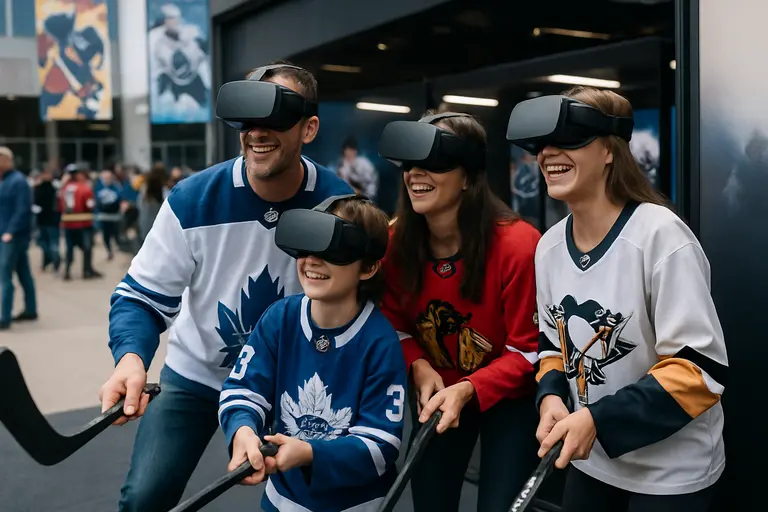
For spectators, the promise is more than a live stat feed. With NHL EDGE data and Hawk-Eye tracking tied into visualization tools, fans could see speed, shot location, offensive pressure and zone activity in a form that explains the action. The NHL and Sofascore partnership described in the research points toward live event mapping, richer shot maps, offensive intensity metrics, attack zone data and expected goals models on fan platforms in real time.
The caution is that hockey crowds do not all want the same thing. Some fans want raw atmosphere: the boards shaking, the tension before a power play, the hostility of a divisional matchup. Others want context for why a winger’s route created space or why a defenseman looked beaten before contact happened. The best arena technology will serve both groups by making deeper information available without forcing every fan into the same viewing style.
Gaming As A Bridge To The Real Rink
The research also connects tracking data to video games. On August 11, 2025, NHL material described EA SPORTS NHL 26 as using real NHL EDGE player- and puck-tracking data in its ICE-Q 2.0 gameplay engine, with the game scheduled for September 12, 2025. By October 6, 2026, that date had passed, so the relevant point is retrospective: the integration marked a notable step in connecting real player movement, shot power and skating traits to a consumer hockey game.
That link between virtual hockey and arena hockey may shape expectations. Fans who learn player tendencies through a game may arrive at the rink with a sharper eye for acceleration, release speed or defensive spacing. For related coverage on how digital testing connects to fan trust, Dashers Hockey has examined NHL 26 fan impact. Cross-sport technology comparisons can also be useful, and the same network covers global football through world football coverage, where fan data and match presentation are also growing parts of the spectator experience.
NHL Innovation Lab Game-Day Questions
What Still Needs Proof
The NHL Innovation Lab should be judged by what reaches real arenas and improves actual game nights. The current research supports several credible directions: 5G-enabled communications, official alerts, richer video workflows, better display systems, live tracking visualizations and student-driven ideas for infrastructure, navigation, concessions and sustainability. The Hockey Innovation Competition, which culminated on March 25, 2026, showed that the league and NHLPA were also inviting university teams to think about arena infrastructure and fan experience.
Still, the available research does not provide fan survey results, adoption timelines for each arena or proof that every tested feature will become a standard NHL game-day tool. That uncertainty is not a weakness if the league treats the lab as a filter rather than a showroom. Hockey has enough natural drama: open-ice collisions, bench tension, rivalry grudges, late goalie pulls and the emotional swing of a reviewed goal. Technology should help fans and participants read those moments more clearly.
The strongest case for the lab is practical. If a coach gets useful video faster, if an official receives a discreet timing alert, if fans see a clean explanation of pressure or puck movement, then technology has supported the game rather than distracted from it. The standard should remain simple: keep hockey fast, keep the information trustworthy and let the sport’s competitive spirit stay at center ice.