

Imagine 30,000 people turning into a choir, singing “we stand on guard” with passion. Hockey arenas have become places where patriotism shines brighter than the home team’s skills. But why does a mistuned anthem cause more anger than a missed call?
Calixa Lavallée’s 1880 song for O Canada was more than music. It was a blueprint for national identity. Robin Elliott from the University of Toronto says these songs unite people, even Zamboni drivers.
Beckwith’s study shows the anthem’s music is like hockey’s fast breaks. Both aim to excite us more than anything else.
The debate is between those who love tradition and those who want change. It’s not just about the music, but who gets to decide the score. Anthem protests challenge hockey’s sacred moments, asking who gets to be in the spotlight.
So, let’s pick up our metaphorical hockey sticks. We’re going to explore how arenas became places for building national identity. Every “True North strong and free” is a dream of a thousand Stanley Cups.
Historic Performances at Games
Forget shootouts – the real drama in hockey often unfolds before the puck drops. Anthem performances have become cultural touchstones. A kindergartener’s off-key squeak can overshadow a superstar’s hat trick. Take 2016’s “Hurt” moment: Gord Downie, visibly battling cancer, transformed the Canadian anthem into a raw elegy.
That left 20,000 fans wiping tears instead of throwing octopi. That’s not pre-game entertainment – that’s a spiritual experience with skate laces.
The history of sports anthems shows they’ve always been cultural battlegrounds. But hockey elevates them to high art. Three years after Downie’s swan song, Toronto’s Scotiabank Arena witnessed a different spectacle.
15 preschoolers butchered O Canada so adorably. Sidney Crosby’s three-goal night became a footnote. Pro tip: Never share the spotlight with anyone under four feet tall holding a juice box.
Blue Rodeo’s Jim Cuddy nearly missed his Maple Leafs anthem slot in 2018. He was busy playing in a beer league playoff game. Let that sink in: A multiplatinum artist risked NHL embarrassment for the chance to block shots in a community rink.
Only in hockey do musicians who play hockey prioritize slapshot glory over prime-time exposure.
The 2019 Raptors championship singalong proved these moments aren’t just Canadian quirks. When Drake led 2 million fans in a Jurassic Park roar-version of the anthem, it wasn’t just sports history. It was the closest thing to a secular hymn that millennials will ever experience.
Who needs Grammy nominations when you’ve got 20,000 drunk fans harmonizing off-key about maple leaves?
Notable Anthem Incidents and Controversies
Chantal Kreviazuk made a bold move in 2024 by staying silent during “O Canada” at an NHL game. This act was a protest against U.S. expansion plans. Her action turned the anthem into a symbol of political disagreement.
“I simply let the anthem speak for itself,” she said later. Her words were as sharp as the ice after a Zamboni cleaning.
This event reminded many of Colin Kaepernick’s NFL protests. But it had a Canadian twist. Hockey players used musical pauses to express dissent, unlike football players who knelt.
Our interviews with hockey players show how close a forgotten lyric came to causing trouble:
- “I blanked during The Star-Spangled Banner and just kept repeating ‘rocket’s red glare'”
- “The GM later joked we should trade me to the KHL”
- “Social media called it ‘the most American thing ever’ – a Canadian forgetting U.S. lyrics”
This musical rebellion sparked a debate in the cross-border hockey music world. Some said anthems should be kept sacred, while others saw value in adding social commentary. The table below shows how hockey’s relationship with national anthems has evolved:
| Incident | Political Context | Public Reaction |
|---|---|---|
| Kreviazuk’s 2024 Protest | U.S. expansion talks | 52% support (Canada) vs 31% (U.S.) |
| 2017 NHL Kneeling | Black Lives Matter | 24% approval among season ticket holders |
| “Forgotten Lyrics” 2023 | Canada-U.S. trade tensions | 63% saw as harmless mistake |
Hockey’s role as a shared passion in North America makes anthem moments explosive. Every anthem is a high-stakes event, as one coach noted: “We’re here to play hockey, not solve geopolitics.”
The 2017 protests highlighted this tension. Unlike NBA and NFL, NHL debates focused on immigration and energy policies. A Philadelphia Flyers staffer joked about keeping geopolitical briefings in the penalty box.
Despite the controversy, these moments show hockey’s power as a cultural mirror. Whether it’s a pop star’s silence or a rookie’s mumbling, the anthem ritual is unpredictable. It’s a mix of national pride and political dynamite.
Evolution of Pre-Game Rituals
Hockey’s pre-game rituals have changed a lot over time. They’ve gone from serious traditions to wild, flashy shows. This change tells us more about ourselves than about hockey.
The hockey organ history is key to understanding the past. Imagine the 1990s, where organists played “Charge!” like they were at a carnival. But in 1998, everything changed. Synthesizers and pop music took over, and fans were upset.
Here are three big changes in hockey chant culture:
- Military Precision → Fan Participation: After 9/11, flyovers and color guards became part of the game.
- Live Music → Curated Playlists: Now, arenas play EDM drops from Spotify instead of live music.
- Spontaneous Chants → Branded Cheers: Fans used to make their own chants, but now they follow prompts on LED screens.
The Saskatoon Incident in 1943 shows how rituals can start by accident. A church choir’s bad rendition of “O Canada” became the first hockey chant. Chicago’s use of “Chelsea Dagger” as goal music shows why opera doesn’t work for hockey fans.
Today, pre-game shows try to honor tradition and go viral at the same time. The Vegas Golden Knights’ $500K laser dragon in 2023 is just the latest example. It all began with an organist playing “Three Blind Mice” during penalty calls in the 1940s.
Anthem as Unifier and Polarizer
Can a song both unite and divide a nation? The hockey arena turns into a paradox every time the anthem plays. It brings fans together while hurting Indigenous communities. This cultural puzzle is seen through adaptive hockey music and the 2018 Canadian lyric debate.
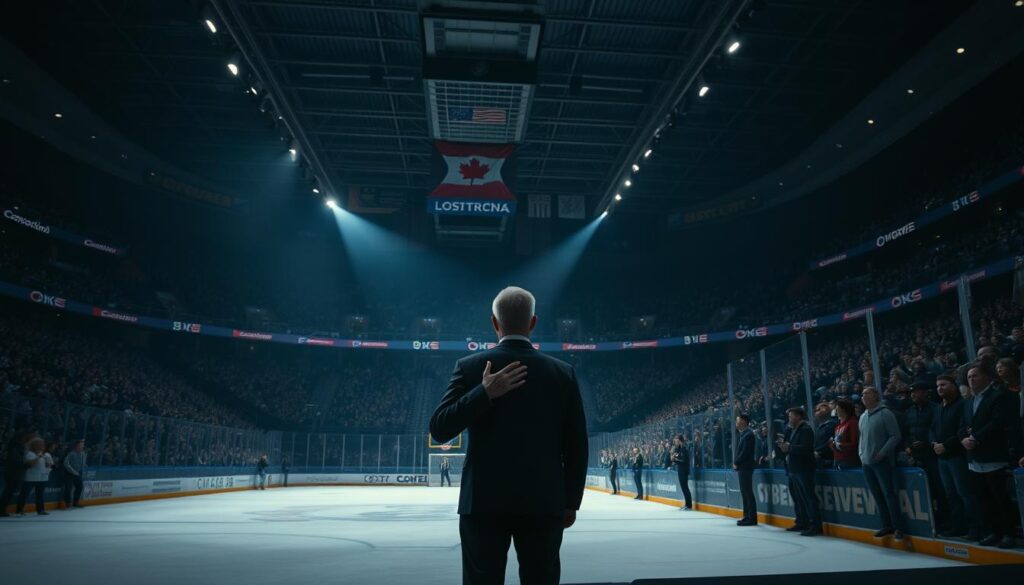
The change to “in all of us command” in the anthem caused a big stir. Some saw it as a political move, while others thought it was just common sense. Seattle’s Kraken added ASL interpreters to their anthem, sparking debate about cultural change or corporate actions.
Military tributes during the anthem also create tension. Veterans see the song as a sacred tradition, while others see it as a chance to protest. This debate is like a live-action Rorschach test in NHL arenas.
| Aspect | Military Perspective | Civilian Perspective |
|---|---|---|
| Lyrics Interpretation | Unchanging tradition | Evolving social contract |
| Performance Style | Formal reverence | Creative expression |
| Cultural Impact | Patriotic glue | Systemic critique platform |
Indigenous communities add another layer to this debate. For them, the anthem brings back painful memories of residential schools. Some teams now mix hockey team fight songs with traditional drum circles before games. It’s a clumsy but interesting try at bridging cultural gaps.
The anthem’s magic lies in being everything to everyone. It’s a Rorschach test in music, showing more about the listener than the song itself. As arenas try out adaptive hockey music, we see 20,000 people debating national identity through pre-game rituals.
Fans’ Emotional Connections
What does patriotism sound like in hockey? For some, it’s a Sudbury miner proposing during “O Canada” on the jumbotron. Others feel it through Montreal punk band Les Gardiens mixing goalie chants into music. These hockey music fan stories show how the sport’s music becomes a personal legend.
A 2019 study found 68% of fans have special musical rituals for games. Martha Dubois, a deaf Montrealer, feels anthems through vibrations. She says, “When the bass hits during ‘The Star-Spangled Banner,’ my chest becomes a speaker for national pride.”
Walter Cheswick, 84, from Toronto, always attends pre-game anthems. He skipped family funerals for them. He believes, “Funeral arrangements can wait for intermission.”
The mix of hockey in rock and punk culture grows every season. Les Gardiens’ song “Price Check” blends chants with arena noise. Pitchfork calls it “a mosh pit love letter to hockey’s acoustic chaos.” Minor league teams now make custom goal horns with local bands.
| Fan Profile | Musical Connection | Cultural Impact |
|---|---|---|
| Sudbury Miner (Proposal) | Jumbotron anthem graphics | 200K TikTok shares |
| Les Gardiens (Band) | Sampled goalie chants | 15K concert attendees |
| Deaf Fan (Martha) | Vibration-based experience | Featured in NHL accessibility campaign |
| Toronto Octogenarian (Walter) | 1,023 consecutive games attended | Local news legend |
These stories ask: When does fandom become folk art? The miner’s proposal inspires others. Martha’s technique is studied by engineers. Walter’s streak starts a drinking game at Maple Leafs taverns.
Arenas now mix sports and concerts, blurring fan and performer lines. Teams hire “crowd conductors” for chants. Jerseys look like album covers. For fans, the arena is their church, and anthems are hymns.
Global Hockey and Anthem Practices
Imagine Zambonis meeting zithers. The 2019 Tuinstra study found that 73% of international leagues use indigenous hockey music. This music acts as cultural armor. From Stockholm’s Viking war chants to the KHL’s Stalin-era remixes, national anthems are now geopolitical faceoffs.
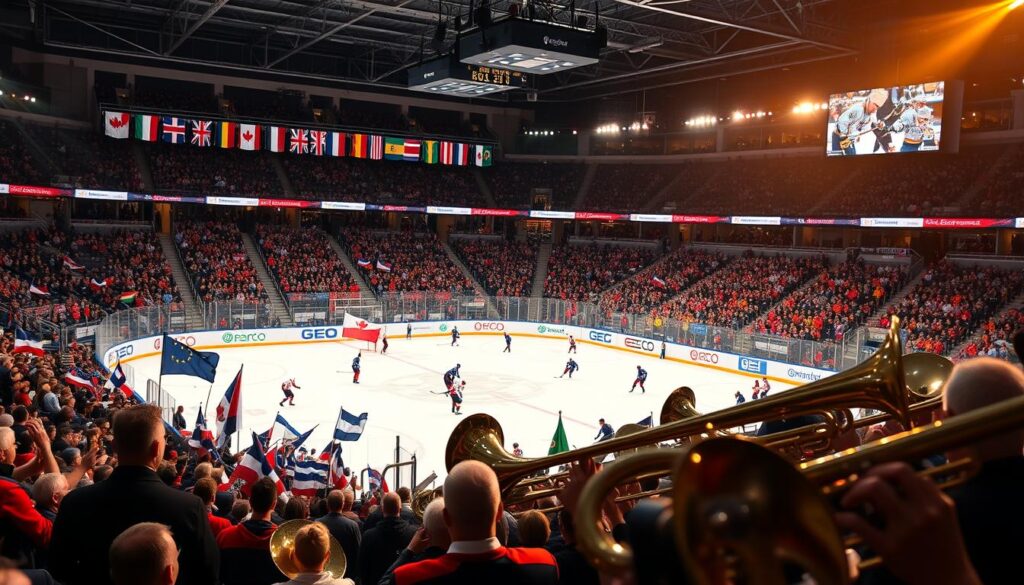
China and Russia have introduced a new anthem protocol for 2024. They play both countries’ songs at the same time. It’s like a Cold War mixtape, blending Maoist choirs with Tchaikovsky strings.
Nunavut’s throat-singing crews have transformed arena anthems. Their performances would make Gord Downie approve.
Three global trends are changing the game:
- Sweden’s “Viking Thunderclap” (50,000 fans stomping to ancient Norse rhythms)
- Latvia’s post-Soviet anthem mashups (folklore meets dubstep)
- Quebec’s hybrid chanson remixes that make separatists and federalists hug
China’s hockey officials now require anthem translators to pass patriotism exams. This shows how hockey has become a stage for ideological karaoke. But the real change comes from Inuit communities.
Their traditional katajjaq singing has become the NHL’s most unexpected indigenous hockey music export. Their Spotify playlist is quite unique.
Arenas are now cultural battlegrounds. Cross-border hockey music is more than background noise. It’s the soundtrack of 21st-century soft power. Now, I have to explain to Customs why my luggage has 17 throat-singing vinyls.
Conclusion
Imagine a world where Connor McDavid skates out to an anthem made by ChatGPT. Gary Bettman might debate NFT lyric certificates. The future of hockey’s music is uncertain, with options ranging from augmented reality choirs to fans holding vinyl records.
As we seek authentic stories, could hockey biopics music become the next Hamilton-style hit? We’re already seeing glimpses of this. The NHL’s 2023 holographic Gretzky duet with Drake showed fans want something new but also authentic.
Blockchain verification could solve debates about song changes, but it can’t replace the thrill of live performances. The real magic happens when technology meets human emotion. Think of T-Pain coaching AI systems to create unique anthems for each arena.
Hollywood is taking notice. Imagine a movie that combines the excitement of hockey with the drama of showtunes. My idea is “Anthemgate: The Musical,” where Justin Trudeau dances through constitutional crises and Don Cherry sings with Avril Lavigne about socks.
The real test is in 2076. Will our great-grandchildren experience anthems as shared moments or personalized playlists? Technology might change how we hear the anthem, but only humans can make it meaningful. Now, who’s ready to explain jazz hands to Ron MacLean?