

ECAC matchups can carry more than two points or one line on a national schedule. Cornell vs. Colgate and Princeton vs. Minnesota sit in different competitive lanes, but both games point toward the same larger question: how much pressure can a team absorb when rivalry, ranking context, and standings leverage meet on the same sheet of ice?
ECAC Matchups With Standings Pressure
The Cornell-Colgate men’s home-and-home is scheduled for January 29, 2027 at Cornell in Ithaca, New York, and January 30, 2027 at Colgate in Hamilton, New York. Colgate lists the January 30 game on its official men’s hockey schedule, confirming the second half of the series as an ECAC conference date Colgate schedule. That format matters because back-to-back rivalry games leave little time for emotional reset. A team that loses the first night has one day to adjust, travel, and answer physically without letting frustration take over its structure.
As of November 9, 2026, the available schedule-and-results data in the research notes has Cornell’s men at 1-1-0 early and Colgate at roughly 1-7-0, placing Colgate near the bottom of the ECAC picture. Those records should be treated as an early snapshot, not a complete judgment on either roster. Still, they help explain why the January series has standings weight. Cornell is positioned as the steadier side in the early read, while Colgate has more urgency to convert rivalry intensity into points rather than penalty trouble or broken coverage. The league schedule board provides the early ECAC results context ECAC schedule board.
ECAC Matchups And Rivalry Temperature
Rivalry hockey often gets reduced to hits, scrums, and post-whistle tension. Those parts are visible, but they are not the full competitive story. The best rivalry teams usually turn the emotional edge into forecheck timing, cleaner exits, and better discipline after whistles. In the Cornell-Colgate case, that distinction is central. A physical start can set tone, but a parade to the penalty box can hand the other bench control of matchups and tempo.
That is why the “fight” in this rivalry should be read as a contest for territorial control and composure as much as confrontation. Cornell’s task is to keep the game from becoming loose if it enters January with better form. Colgate’s task is to make the series uncomfortable without chasing the game emotionally. ECAC matchups at this point in the schedule tend to punish teams that confuse rivalry heat with useful pressure.
Why Two Dates Matter For Cornell And Colgate
The January 29-30 structure gives both staffs a direct test of in-series adaptation. If Cornell controls the middle of the ice in Ithaca, Colgate’s response in Hamilton could reveal whether its early-season struggles were tied to execution or deeper matchup problems. If Colgate drags the first game into a lower-event, more physical contest, Cornell’s response the next night may show whether its steadier early form can travel under pressure.
The research notes also state that last season’s regular-season meetings were split, with Colgate winning at home and Cornell taking an overtime win in Ithaca, before Cornell swept Colgate in the ECAC semifinals. Because that historical note comes from outside the approved source list for links, it should be handled cautiously. Even so, it fits the broader competitive pattern: this pairing has recent memory attached to it, and that memory can sharpen bench management, line-matching choices, and emotional stakes.
Cornell Vs. Colgate: Home-And-Home Stakes
For Cornell, the key is not only beating Colgate. It is doing so in a way that holds up against the conference grind. A home game on January 29 gives Cornell last change, familiar routines, and the first chance to define the pace of the series. If Cornell plays from ahead, it can force Colgate into riskier breakouts and longer defensive-zone shifts. That is where a rivalry game can become a standings game: the team with more patience can make the emotional opponent overextend.
For Colgate, the home game on January 30 is the built-in counterpunch. If the Raiders enter that weekend still trying to climb out of the lower part of the ECAC standings, one win over Cornell would carry practical and psychological value. It would not erase early losses by itself, but it would give the group a direct result against a familiar opponent and may help steady a season that, through the research snapshot, had started poorly.
There is also a player-development angle. Young college players often learn conference hockey through repeat opponents and rivalry stress. A home-and-home against a nearby rival forces quick film corrections: cleaner puck support below the goal line, fewer soft clears, smarter changes, and more restraint after contact. Coaches can preach those habits in October and November, but a January rivalry weekend tests whether players have absorbed them.
For readers tracking the wider league race, the related ECAC talent and development preview gives useful context on how roster-building and continuity shape conference expectations. That lens applies here because Cornell-Colgate is not just a rivalry marker; it is a check on whether each program’s development curve is translating into conference results.
Princeton Vs. Minnesota At D1 In DC
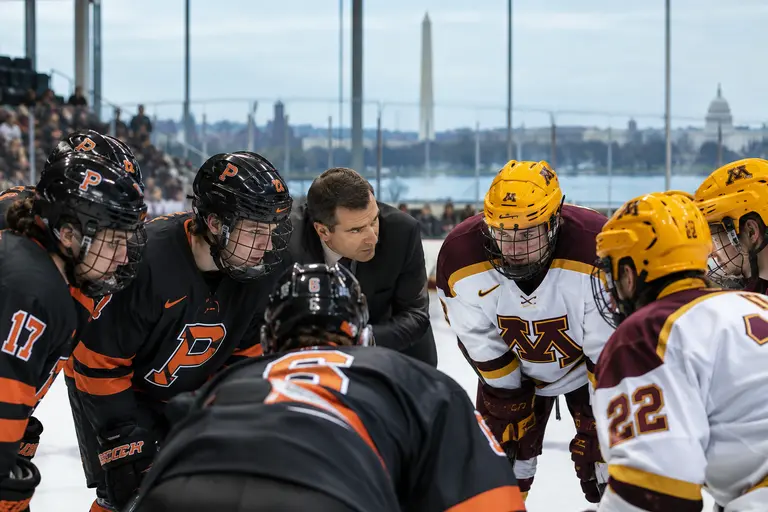
The women’s game between Princeton and Minnesota is different from Cornell-Colgate because it is not an ECAC league game, but it still belongs in the same discussion of high-pressure ECAC matchups. The research notes list Princeton, ranked No. 5, meeting Minnesota on November 27, 2026 at MedStar Capitals Iceplex in Washington, D.C., as part of the D1 in DC tournament. The notes also state Minnesota has opened 6-0-0. Because the approved source list for this assignment does not include the women’s schedule sources from the research file, those details are presented as research-supported but not independently linked here.
Neutral-site games create a specific kind of pressure. Neither team gets the full benefit of home-ice routine, and tournament settings can compress preparation windows. That does not make the game random. It can make bench discipline, goaltending rhythm, and special-teams composure more visible. Princeton’s ECAC identity meets a Minnesota program from the WCHA, and the result can influence how observers compare top teams across conferences.
National Read Without Conference Points
Princeton cannot gain ECAC standings points by beating Minnesota on November 27, 2026. Yet the game can still shape perception. A strong performance against an unbeaten Minnesota team would say something about Princeton’s pace, depth, and ability to handle pressure outside the conference schedule. A difficult result would not define Princeton’s season by itself, but it could identify areas that need tightening before the ECAC race deepens.
For Minnesota, the matchup tests whether its early 6-0-0 form travels into a neutral setting against a ranked ECAC opponent. The research notes identify it as the first and only regular-season meeting between the programs in 2026-27, which increases the sample’s scarcity. One game is never enough to settle a conference comparison, but it can carry weight because there may be no direct rematch before postseason selection debates or national ranking movement.
Physical Edge Without Losing Structure
High-end women’s college hockey is often decided by speed through the neutral zone, puck retrievals, and special-teams detail. The physical edge is still present, but it has to stay within the rules and within the team’s system. Princeton’s challenge is to match Minnesota’s early-season confidence without opening gaps between forwards and defense. Minnesota’s challenge is to handle a ranked ECAC opponent without assuming its early record alone will tilt the ice.
That makes this game an important comparison point for ECAC matchups even without conference points attached. A neutral-site tournament can strip away some home-rink comfort and show which team can establish identity fastest. For those interested in exploring related sports activities, the same network includes Copeland Hills Golf, offering a different seasonal focus.
ECAC’s Key Match-Ups: Cornell-Colgate And Princeton-Minnesota
Taken together, Cornell-Colgate and Princeton-Minnesota show two versions of hockey pressure. One is a conference rivalry with standings points, recent competitive memory, and back-to-back emotional demands. The other is a neutral-site national measuring stick that can affect how Princeton is viewed beyond the ECAC table. Both require discipline more than noise.
The men’s home-and-home on January 29 and January 30, 2027 will ask Cornell and Colgate to manage rivalry energy over two consecutive nights. The women’s game on November 27, 2026 will ask Princeton to measure itself against Minnesota in a setting where national perception may shift faster than conference standings. That is the common thread: the fiercest games are not always the ones with the most chaos. Often, they are the ones where teams keep their structure while the rivalry tries to pull them away from it.