

Blackhawks Venue Plans now sit at the center of a larger Chicago sports-business discussion: how much can arena districts, practice facilities, and year-round event programming add to postseason event value? As of October 4, 2026, the clearest evidence points to two connected projects. One is the United Center’s long-range 1901 Project around the Blackhawks’ home arena. The other is the Blackhawks’ separate investment in an expanded ice center designed for more than NHL practices.
The postseason angle should be treated with care. The available figures describe annual economic impact, jobs, tax revenue, visitors, housing, and facility use. They do not provide a separate estimate for a Stanley Cup Final, NHL Draft, All-Star event, NCAA hockey event, or other major postseason-style date. That means any evaluation has to separate confirmed projections from reasonable sports-event logic. Better infrastructure can help Chicago host and absorb major events, but the specific return from any one event would depend on scheduling, hotel demand, broadcast footprint, visitor spending, and how much spending stays near the arena.
What Blackhawks Venue Plans Change For Event Economics
The United Center’s 1901 Project is the largest number in the discussion. The project is described as a $7 billion privately funded mixed-use redevelopment around the arena, covering roughly 55 acres of surface parking lots on Chicago’s Near West Side. Once stabilized, it is projected to generate about $4.5 billion annually in economic impact and $104 million per year in tax revenue for Chicago, according to the United Center project page. Those are long-range figures, not postseason-only figures, but they frame why the arena district matters for sports tourism.
The United Center already has a strong event base. Research notes that the arena hosts more than 200 events per year and draws about 3 million visitors annually. For postseason events, that matters because the venue is not trying to prove basic demand from scratch. It is trying to convert an already active arena site into a broader district that can keep fans, media, sponsors, families, and team-related gatherings nearby before and after games.
Blackhawks Venue Plans And The Fan District Model
Those Blackhawks Venue Plans matter because postseason events are rarely just a three-hour game. A major playoff run or championship series can draw watch parties, alumni appearances, youth hockey tie-ins, sponsor activations, hospitality events, and national media activity. A district with housing, retail, gathering space, and better non-game uses can capture more of that activity near the venue instead of sending it elsewhere in the city.
The evidence is still projection-based. The 1901 Project has been tied to estimates of about 32,000 construction jobs during build-out and 7,000 permanent jobs after completion. The full project has also been described as running toward a 2040 completion point. That timeline matters. A postseason event held before later phases are complete would not draw on the full projected district value. The project’s economic case is strongest as a long-term arena-neighborhood plan, not as a quick boost tied to one playoff date.
Housing, Jobs, And The Local Test
The redevelopment plan also includes a social and neighborhood test. Research notes about 9,500 total residential units, with around 1,900 planned as affordable housing. For sports economics, this is not a side issue. If a venue district raises event spending while pricing out nearby residents or replacing daily neighborhood use with occasional entertainment traffic, the civic return becomes harder to defend.
That is why postseason value should be measured in more than gross spending. Local hiring, permanent jobs, tax revenue, transit access, small-business participation, and public safety costs all shape the real return. The United Center plan is privately funded, based on the research provided, which changes the public-finance discussion. Still, public impact depends on whether the projected tax revenue and neighborhood activity materialize over time.
Practice Ice Center Value Beyond NHL Nights
The Blackhawks’ practice-and-ice investment adds a different kind of economic activity. The team announced a $65 million expansion of the former Fifth Third Arena, rebranded as Blackhawks Ice Center, with two new rinks, including one 2,000-seat arena, Centennial Hall as a team Hall of Fame, upgraded amenities, and new hospitality spaces. The expansion was expected to draw 1.5 million visitors per year and was scheduled to open in January 2026, according to the Blackhawks release.
This part of the plan is important because it spreads hockey activity across the calendar. NHL home games and postseason dates are high-intensity events, but youth hockey, amateur tournaments, community programming, training, and non-game functions can create steadier traffic. In economic terms, a year-round hockey facility can make the sport less dependent on whether the NHL club reaches a given playoff round.
Postseason Spillover From Amateur Hockey
The strongest postseason link may come through hockey culture rather than one event balance sheet. If the expanded ice center supports more youth and amateur hockey, it can build local participation and keep families connected to the Blackhawks brand outside the NHL schedule. During a postseason run, that foundation can turn into watch parties, alumni programming, youth showcases, and community events that give playoff dates more local reach.
The risk is that visitor projections are not the same as verified spending. A facility may draw large numbers, but the impact depends on visit length, food and retail patterns, parking, transit use, and whether users come from outside the local area or simply shift spending from one Chicago venue to another. Blackhawks Venue Plans should be judged against those harder questions as the facilities move from planning documents into repeated event use.
Postseason Event Upside And Fan Experience Limits
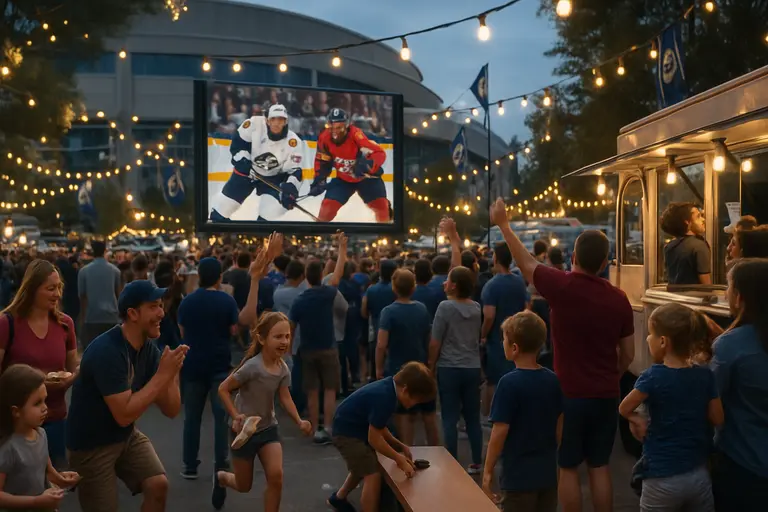
For fans, the venue district idea is easy to understand. A postseason game feels bigger when the surrounding area can support pregame meals, gathering space, family-friendly programming, team history, and safe movement before and after the final horn. The United Center has long handled large crowds, but a district model can change the rhythm of the visit by giving fans more reasons to arrive earlier and stay later.
That said, fan experience is not improved by construction alone. If prices rise too sharply, if transit remains difficult, or if local businesses are pushed aside by national chains, the district can feel less connected to the hockey community. The best arena districts work because they support both major-event visitors and regular neighborhood use. That is the standard Chicago’s Near West Side project will face across a build-out that runs for many years.
Comparing Arena District Lessons
Other cities have used arena upgrades to support more than the home team’s schedule. Nashville’s venue discussion offers one useful comparison, especially around concourses, displays, event logistics, and non-NHL uses, as covered in this analysis of Bridgestone Arena renovation. The lesson for Chicago is not that every venue can copy another market. It is that postseason value often depends on all-day logistics, not only the game presentation.
Chicago also has a broader sports-community context. To explore similar dynamics and regional influence, interested readers can visit Texas Sportsmen to get a related perspective. For the Blackhawks, the question is how much of the new arena activity feels rooted in hockey culture rather than only real estate development.
Blackhawks Venue Plans For Chicago Postseason Events
Blackhawks Venue Plans give Chicago a stronger long-term case for postseason and major hockey events, but the supported facts point to measured optimism rather than certainty. The 1901 Project’s $7 billion investment, projected $4.5 billion annual economic impact, $104 million in yearly tax revenue, and long completion window through 2040 suggest a major reshaping of the United Center area. The Blackhawks Ice Center expansion points toward year-round hockey use, youth participation, and a larger community footprint.
The economic impact of a specific postseason event remains uncertain because the research does not provide event-by-event estimates. What can be said is narrower and more defensible: a larger arena district, more hospitality capacity, expanded hockey facilities, and steadier visitor traffic can improve Chicago’s ability to host and benefit from major events. The harder work will be proving that those gains reach local workers, residents, fans, and small businesses, not just project balance sheets. That is the real test of whether the plans strengthen Chicago’s hockey community as much as its event economy.