

The Post-Kopitar Strategy in Los Angeles is less about replacing Anže Kopitar with one player and more about rebuilding the daily structure around several voices. Kopitar retired at the end of the 2025-26 NHL season, which concluded on April 26, 2026, after leading the Kings with 38 points in 67 games, including 12 goals and 26 assists, according to an NHL roster review. That exit removed a captain, a matchup center, and a stabilizing figure from a room that now has to define itself before the 2026-27 season begins on September 29, 2026.
The club has already framed the transition symbolically. Kopitar’s No. 11 is scheduled to be retired, and a bronze statue is scheduled to be unveiled on February 24, 2027, before a game against the Montreal Canadiens at Crypto.com Arena. For more on how the franchise is treating that legacy moment, Dashers Hockey has covered Kopitar’s legacy in a separate piece.
Post-Kopitar Strategy And The Leadership Reset
The Kings did not answer Kopitar’s retirement with a single sweeping move. They hired Peter Laviolette as head coach on June 9, 2026, added older forwards and defense depth in free agency, and left room for younger players to take bigger assignments. Laviolette, 61, arrived with a Stanley Cup win and multiple Stanley Cup Final appearances on his coaching record. That matters in a dressing room moving away from a captain who set standards for two decades.
Laviolette’s Assignment
Laviolette’s task is not only tactical. He has to set a competitive tone without copying the Kopitar era. Hockey leadership is tested in the hard minutes: defensive-zone faceoffs, late-game shifts, playoff-style checking, and the emotional spikes that come with rivalries. The Kings have long operated in a division where heavy forechecking and physical pushback can decide shifts. A coach with Laviolette’s background gives the roster a clear adult presence while younger players learn what pressure feels like without Kopitar absorbing the first wave.
The leadership group is also being recast from within. In spring 2026 exit interviews, players identified Drew Doughty, Adrian Kempe, and Mikey Anderson as internal candidates for more responsibility. Kempe has described himself as quieter and more game-focused, while Anderson and Doughty are viewed as more vocal presences. That mix is useful. A room does not need every leader to speak the same way; it needs consistency between words, minutes, and habits.
Why The Post-Kopitar Strategy Starts At Center
The most visible on-ice question sits at center. Quinton Byfield is now the clear heir to the role Kopitar occupied for so long. During the 2025-26 season, Byfield led all Kings centers in ice time at a career-high 20:01 per game, scored a career-high 24 goals, and finished just short of a third straight 50-point season. From February through April 2026, he produced 51 points in 59 games, a strong close that supports the organization’s faith in a larger role.
The Post-Kopitar Strategy therefore asks Byfield to do two things at once: drive offense and handle the stabilizing minutes that once belonged to Kopitar. That is a demanding job. It is also the cleanest path for Los Angeles if Byfield’s late-season pace becomes more repeatable over a full campaign.
Veteran Bridge Without Blocking The Kids
The Kings did not acquire a long-term top-six center during the 2026 offseason. Instead, they added veteran depth behind Byfield and around the forward group. On July 1-2, 2026, Los Angeles signed Mats Zuccarello, Erik Haula, Corey Perry, and Erik Gustafsson, while also re-signing Scott Laughton to a three-year deal. NHL.com described the additions as a veteran push to boost offense and support the roster’s transition in its free agency analysis.
That approach carries logic and risk. Zuccarello, 38, Haula, 35, Perry, 41, Gustafsson, 34, and Laughton, 32, bring experience without necessarily closing the door on younger players. The Kings appear to be using veterans as a bridge: players who can absorb shifts, model preparation, and help protect the room from a sharp drop in standards.
Short-Term Help Up Front
The Post-Kopitar Strategy is not a full youth movement. It is a blend. Haula and Laughton give the coaching staff options behind Byfield at center and in matchup situations. Perry adds edge, net-front instincts, and a battle-tested presence. Zuccarello brings playmaking craft. The question is not whether those players have experience; they do. The question is how efficiently that experience converts into support for Byfield, Alex Laferriere, and other younger contributors.
This is where the competitive side of the sport becomes practical. In tight games, young players often learn through repeated contact with veteran habits: how to end a shift without damage, how to respond after a scrum, how to avoid emotional penalties, and how to keep composure when a rivalry game gets louder. Those details rarely fit neatly into a box score, but they shape whether a team can survive the uneven nights that come with transition.
Development Without A Free Pass
Younger players such as Byfield, Brandt Clarke, Laferriere, and Henry Brzustewicz were identified in the research as part of the group expected to challenge for more significant contributions around the 2026-27 roster. The presence of older players should not become a shield from accountability. It should create a higher standard for earning minutes.
- Byfield must prove his late 2025-26 production can hold without Kopitar’s stabilizing presence.
- Clarke must turn a breakout season into a repeatable two-way profile.
- Laferriere and other young forwards need to claim defined jobs rather than temporary opportunities.
- The veterans need to support that growth without slowing the pace of the lineup.
For those interested in sports travel and local explorations, Bass Lake Roadhouse provides related regional reading and insights, offering off-ice travel and local interest coverage as part of the same network.
Byfield And Clarke Carry The Competitive Edge
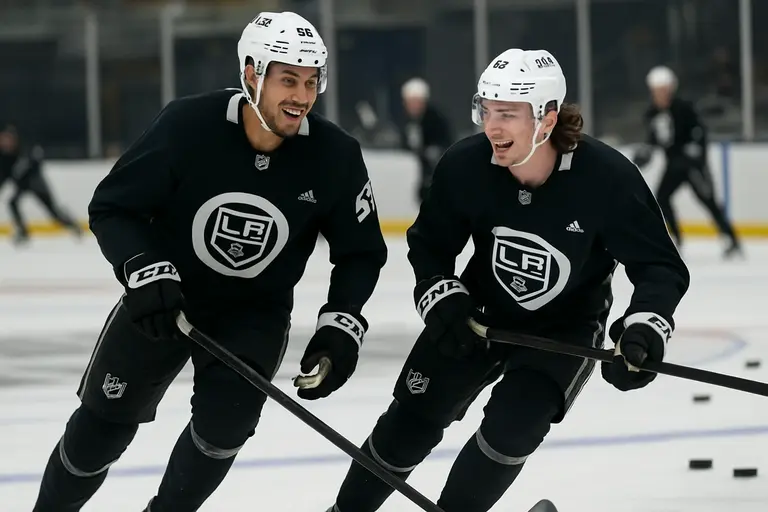
Byfield is the forward most tied to the team’s ceiling, but Clarke may be the clearest sign that the next core is already forming. At 22, Clarke played all 82 regular-season games in 2025-26 and set career bests with 40 points, eight goals, 32 assists, 159 shots on goal, and 185 blocked shots. The research also notes that he was one of only three NHL defensemen last season to reach at least 40 points, 150 shots, and 180 blocked shots.
Blue-Line Growth With Clarke
Those numbers matter because they describe more than offense. A defenseman who shoots, blocks, and produces points is being asked to live in both ends of the rink. Clarke’s next step is not simply adding points. It is handling harder reads, tougher forechecks, and the emotional grind that comes when opponents start targeting a young defenseman as part of their game plan.
The Kings’ older voices should help here. Doughty’s influence, Anderson’s vocal presence, and Laviolette’s structure can give Clarke a firmer environment. Still, growth has to show up in repeatable shifts. If Clarke becomes a dependable top-pair or high-impact second-pair option, Los Angeles gains a major internal answer during a period when chasing outside fixes can be expensive and uncertain.
Physical Pressure And Rivalry Minutes
Post-Kopitar Los Angeles will also need a new emotional identity. That does not mean chasing fights for their own sake. Modern hockey rewards discipline, controlled aggression, and the ability to win confrontations without handing the other team power plays. Perry, Doughty, Anderson, and Laughton all fit different parts of that tone, while younger players learn where the line sits.
In rivalry games, the Kings will be measured by their response after contact as much as by their first hit. The franchise is moving from a captain who could calm a game with possession and positioning to a wider committee that must manage pressure together. That committee approach can work, but it requires clarity. If every player assumes someone else will set the temperature, the room drifts. If the veterans set the standard and the young core matches it, the transition becomes far more stable.
What The Post-Kopitar Strategy Reveals
The Post-Kopitar Strategy reveals a club trying to stay competitive while accepting that its old center of gravity is gone. The Kings honored the past by preparing Kopitar’s number retirement and statue ceremony for February 24, 2027, but their roster choices point toward a practical present: Byfield gets the first chance at the top center job, Clarke is asked to build on a breakout year, and Laviolette plus a group of older additions are there to keep the standard from slipping.
The risk is clear. If the veterans show age, if Byfield’s late 2025-26 surge does not carry forward, or if Clarke’s workload becomes too heavy, Los Angeles may feel the absence of Kopitar more sharply than planned. The upside is also clear. If the bridge holds, the Kings can move into the 2026-27 season with enough leadership to compete and enough youth to avoid standing still.