

Hockey gear prices became a sharper youth sports issue after the United States imposed a 50% tariff on more than 550 goods from Canada on September 7, 2026, including hockey sticks, skates, and goalie gear. The timing mattered because equipment costs had already climbed before the tariff took effect, leaving families, local associations, and rink-based programs with less room to absorb another price shock.
Hockey has always carried a higher entry cost than many youth sports because protective equipment is not optional. A player needs skates, a helmet, gloves, pads, pants, a stick, and team fees before travel or ice time enters the household budget. The position-specific cost is even steeper for goalies, whose gear can shape whether a child gets a fair chance to try the position. That matters to the sport beyond one family purchase. Youth hockey depends on enough participants at each age level to form balanced teams, keep rinks active, and maintain local development pipelines.
Why Hockey Gear Prices Moved Higher
Tariff Timing And Equipment Categories
The September 7 tariff added a new trade cost to Canadian goods after talks between the United States and Canada collapsed, according to an Associated Press report. The affected categories named in the research included sticks, skates, and goalie equipment, which are core purchases rather than optional accessories. For hockey families, that distinction is central: these are items needed for safe participation, not upgrades that can always be postponed.
The effect should be read with care. A tariff does not automatically raise every retail tag by the full tariff rate. Retailers may have existing inventory, suppliers may adjust sourcing, and brands may choose how much of the added cost to pass along. Still, the pressure is real because hockey gear prices were already elevated in several key categories before September 2026.
Hockey Gear Prices And Supply Exposure
The Canadian share of U.S. imports provides useful context. Canadian-made hockey and field-hockey equipment accounted for about 8.5% of U.S. imports in the latest trade data cited in the research, while China supplied 52.7%, Vietnam 13.2%, and Thailand 9.5%, according to The Washington Post. That means Canada was not the dominant supplier by import share, but it still represented a meaningful slice of a specialized sport market.
The same research notes showed how sharp some equipment increases had become. A goalie helmet that cost $400 in 2022 was described as costing about $1,000 by September 2026, while a chest protector listed at $465 in the prior year was selling for roughly $900. Skate prices also had risen over a longer window, with models that ranged from $80 to $900 in 2016 described as ranging from about $200 to $1,230 depending on brand and model. Sticks were cited at around $200 on average, with high-end models reaching $400.
Youth Participation Pressure Points
Where The Cost Barrier Hits First
The access risk is not evenly spread. Families with more income have more ability to replace broken sticks, size up skates during growth spurts, or shift a child from skating out to playing goal. Families with tighter budgets face harder tradeoffs, especially if more than one child plays. The research cited a national survey showing 72.4% of youth from households at or above 400% of the federal poverty threshold participated in sports, compared with 34.8% from households below 100% of that threshold. Equipment costs were identified as one of the hurdles.
That gap matters for hockey culture. Local rinks are strongest when teams reflect the wider community around them. If cost increases narrow participation to families that can handle repeated equipment purchases, the sport risks becoming less accessible at the entry level. That can affect roster depth, house-league numbers, learn-to-play programs, and goalie development.
The Goalie Problem
Goalie costs deserve separate attention because the position requires the most specialized equipment. The research notes placed youth goalie setups above $2,000 and high school, junior, or college-level setups often above $5,000. Even if some families use secondhand gear, hand-me-downs, or association loaner sets, the replacement cycle remains demanding. Masks, chest protectors, pads, gloves, and skates all need to fit well enough for safety and movement.
When goalie costs rise, teams feel it quickly. A club can often rotate skaters through forward and defense spots, but it cannot function well without trained goalies. If a family says no to the position because the gear bill is too high, the effect spreads to teammates, coaches, and league scheduling. That makes goalie access a participation issue, not only a household finance issue.
Community Responses Around Rinks
Used Gear, Loaner Sets, And Local Trust
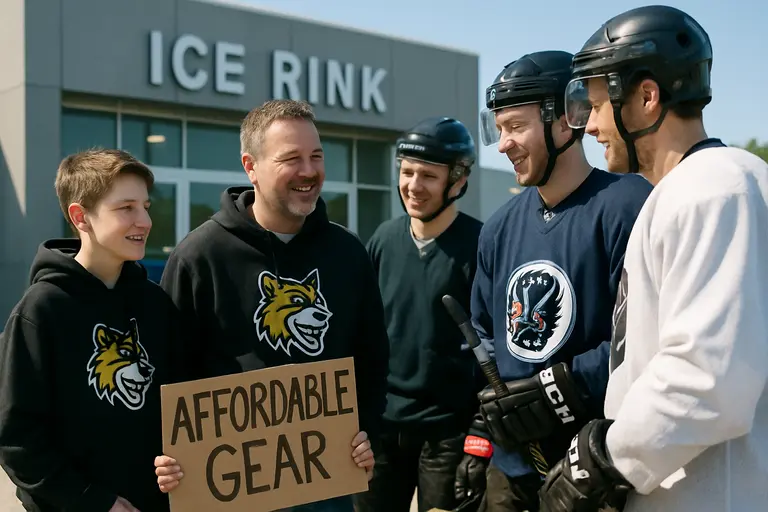
Many hockey communities already use informal cost controls: swap days, used equipment racks, parent-to-parent sales, rink bulletin boards, and association loaner gear. Those systems may become more important after the tariff, especially for younger players who outgrow equipment quickly. The catch is quality control. Helmets, cages, and protective pads must be safe, properly fitted, and suitable for the level of play. A cheaper item that does not protect well is not a true solution.
Associations can reduce risk by treating gear access as part of player development. Clear fitting sessions, basic repair education, and transparent donation programs can help families avoid guesswork. Rinks and clubs also can build trust by explaining which items are safe to buy used and which should be inspected with greater care. For readers interested in equipment design and production methods beyond hockey, CAD/CAM manufacturing coverage offers insights into the engineering complexity behind sports equipment.
What Clubs Can Measure
The most useful local response may be data collection at the association level. Clubs do not need a national study to notice whether learn-to-play sign-ups fall, whether families delay registration, or whether goalie spots become harder to fill. They can track equipment grant requests, swap-day demand, loaner inventory, and dropout reasons at the end of each season. That evidence can help local boards decide whether to fund more rental gear, sponsor first-year players, or prioritize goalie support.
- Track how many first-year players need loaner gear before registration closes.
- Separate goalie costs from skater costs when budgeting support programs.
- Inspect donated helmets and protective equipment before reuse.
- Record whether families cite equipment costs when leaving a program.
These are modest steps, but they fit the way youth hockey actually works. The sport is built through repeated local decisions: one family registering, one volunteer coaching, one rink making ice time available, and one association deciding whether a new player can borrow enough gear to start.
What Hockey Gear Prices Mean For Youth Hockey
Reading Hockey Gear Prices Through Participation
The evidence points to a cautious reading. Hockey participation in the United States was reported as rising by 7% over the prior three years as of 2026, while U.S. spending on hockey equipment increased 45.4% from 2020 to 2025, moving from $228.9 million to $332.9 million. Those two facts can exist together: more people may be playing, while each step into the sport becomes more expensive.
The question is whether the September 7 tariff pushes hockey gear prices high enough to slow that participation momentum, especially in communities without deep booster support or large used-gear networks. The answer is not certain on September 13, 2026. Retailers, brands, associations, and families will respond in different ways, and some inventory may have been priced before the tariff. Yet the risk is clear enough for clubs to act before the next registration cycle forces families into harder choices.
For the sport, affordability is not a side issue. It affects who gets to try hockey, who stays long enough to develop, which communities can support teams, and whether goalies emerge at every level. If local programs treat equipment access as part of the hockey experience, they can protect more than household budgets. They can protect the community base that keeps rinks active and gives the sport its next group of players.